TAPNAV: Humanoid Navigation
through Tactile Active Perception
Anonymous Authors
Anonymous Institutions
Under Review · 2027
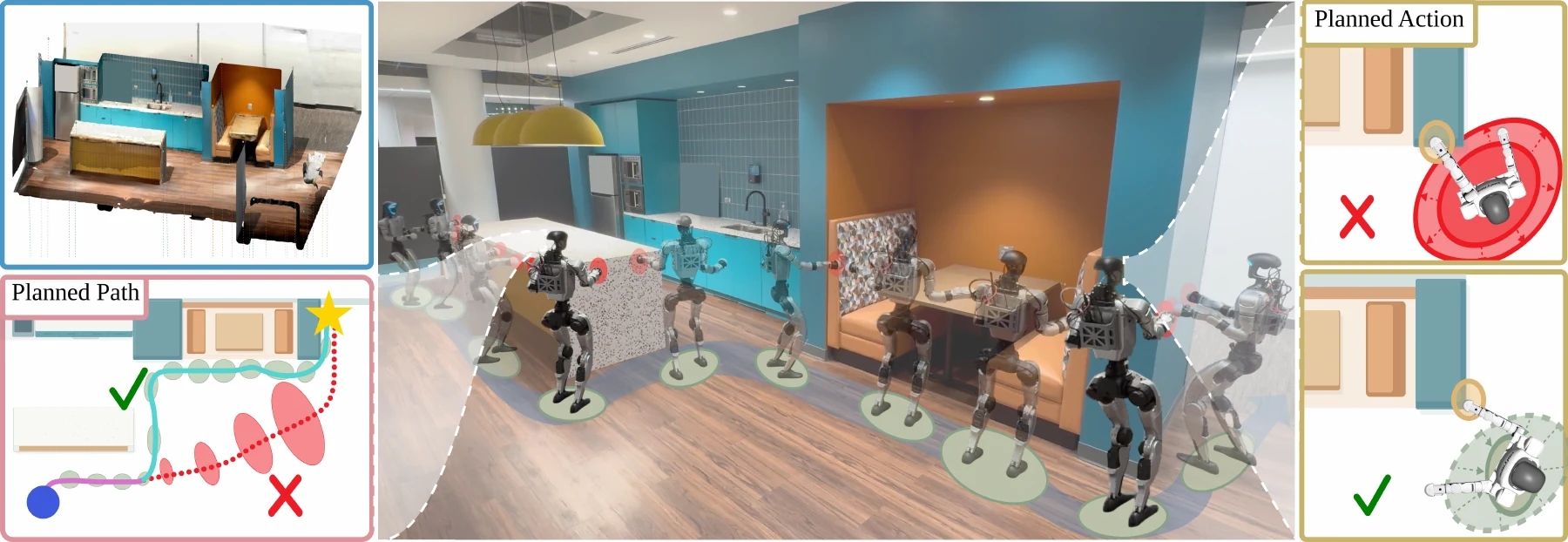
TAPNAV enables vision-denied humanoid navigation through tactile active perception. The
humanoid actively makes contact with the surrounding environment at informative
locations, using contact observations to reduce localization uncertainty and achieve
reliable navigation.
Abstract
Navigation in vision-denied environments is challenging for humanoid robots because
proprioceptive odometry drifts and localization uncertainty accumulates rapidly. We
present TAPNAV, a tactile active-perception framework that enables humanoid navigation
toward a goal by actively probing surrounding structures without relying on vision.
TAPNAV maintains a pose belief from odometry, IMU, and tactile contact observations, and
couples uncertainty-aware global route planning with information-gain-driven local
probing. The global planner searches for routes that keep predicted localization
uncertainty bounded by exploiting opportunities for tactile correction, while the local
planner selects probe actions that maximize expected information gain. A whole-body
controller coordinates the humanoid's locomotion and end-effector contact to execute the
planned navigation and probe motions. We evaluate TAPNAV in simulation and on a Unitree
G1 across different floor plans and obstacle geometries. TAPNAV achieves lower state
estimation error and a higher task completion rate than baselines. These results
demonstrate that actively planning physical interactions with the environment can provide
localization cues for reliable humanoid navigation without vision.
Method
System Overview
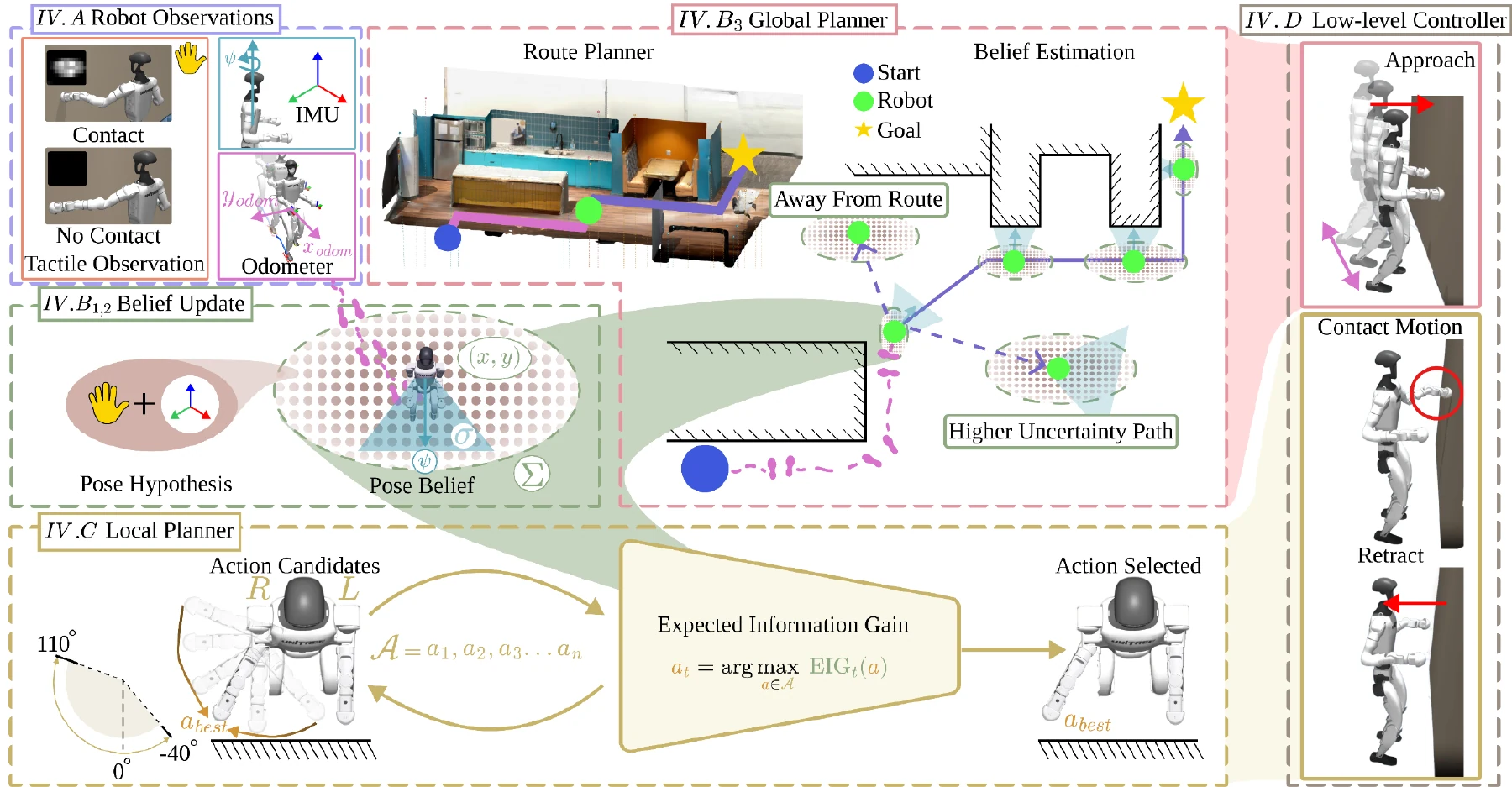
TAPNAV localizes the robot on a known, static map using odometry, an IMU-based heading
estimate, and tactile contact with mapped surfaces. A global route planner, local
tactile action planner, pose estimator, and low-level controller jointly enable
goal-directed navigation without vision.
Odometry, IMU, and tactile observations together update the robot's SE(2) pose
belief. The global planner computes an uncertainty-bounded route with predicted
tactile corrections, the local planner selects informative probes based on expected
information gain, and the low-level controller executes locomotion and probing.
Tactile Sensing and Contact Processing
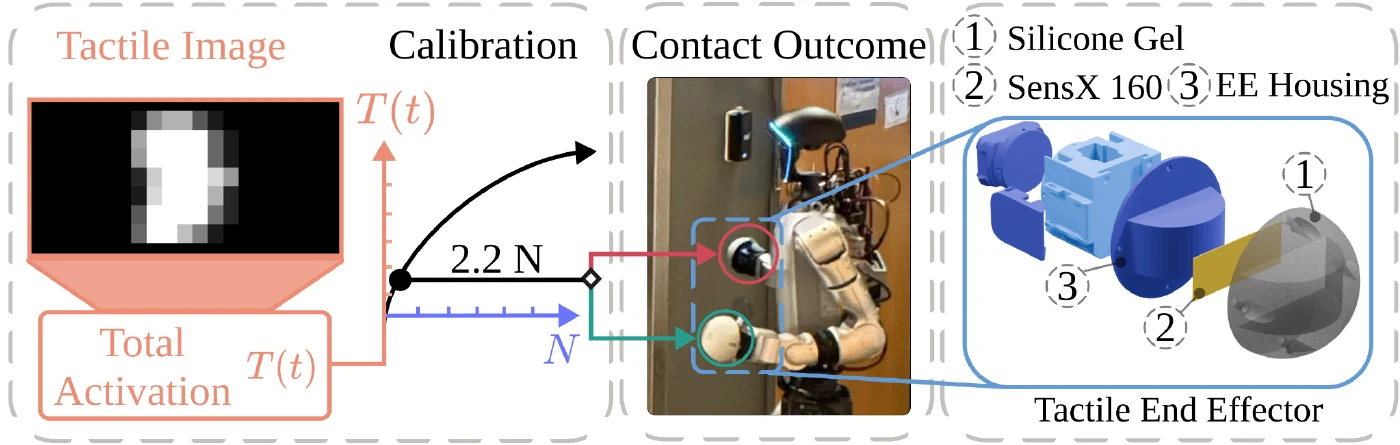
Tactile end-effector design and contact-processing pipeline. The tactile image is
aggregated into a total activation, calibrated to a normal force, and converted to a
binary contact outcome using a force threshold.
Each end-effector integrates a TouchTronix SensX 160 tactile sensor covered by an
Ecoflex 00-50 silicone pad. The tactile image is aggregated into a total activation,
calibrated to an estimated normal force, and thresholded to produce the binary contact
outcome used by the planner.
Low-Level Controller
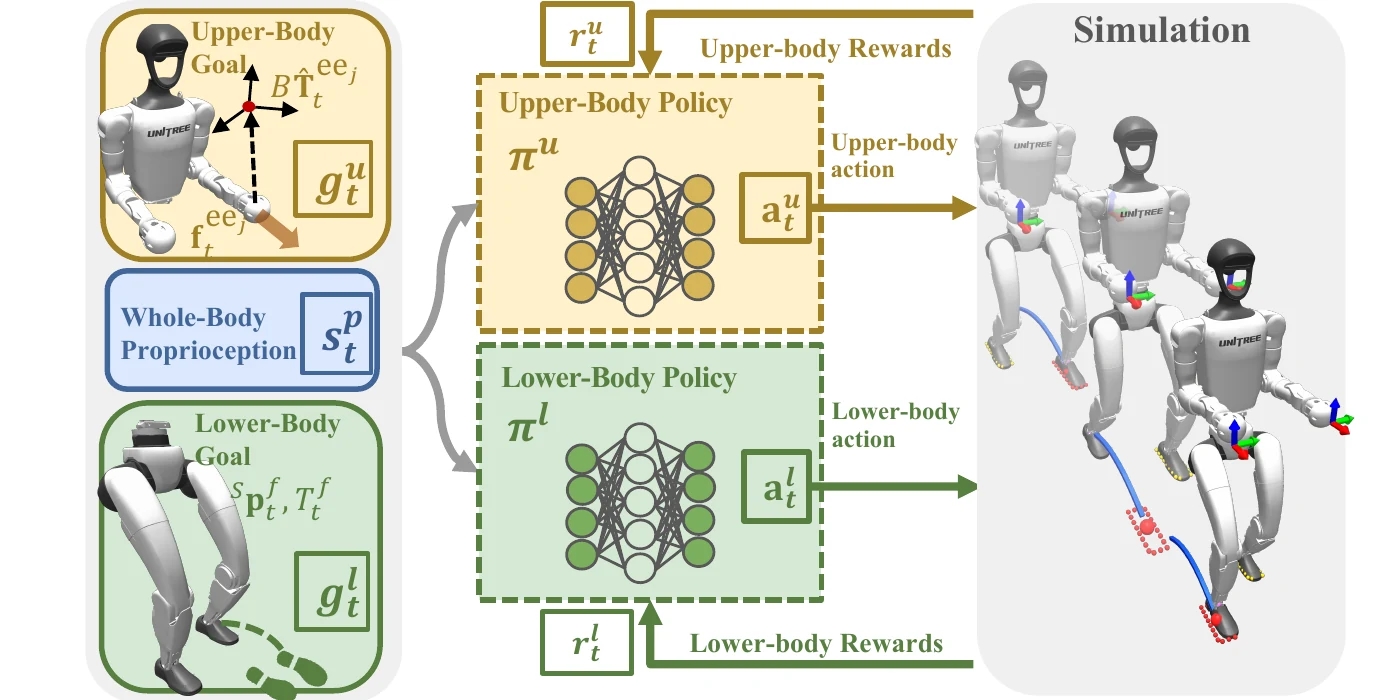
The low-level controller is composed of upper- and lower-body policies. The
upper-body policy tracks target end-effector pose and force, while the lower-body
policy tracks footstep commands. Both policies are jointly trained with shared
whole-body proprioception.
To support frequent stop-and-go maneuvers while maintaining contact with the
surroundings, TAPNAV learns a whole-body controller that tracks end-effector pose and
force together with footstep placement.
Vision-Denied Navigation
TAPNAV actively probes surrounding structures to localize and navigate toward a goal
without relying on cameras or LiDAR.
Humanoid Navigation through Tactile Active Perception
Experiments
We evaluate TAPNAV in MuJoCo simulation and on a Unitree G1 humanoid to examine
uncertainty-bounded state estimation, low-level positioning accuracy, and integrated
real-world navigation.
Simulation Results
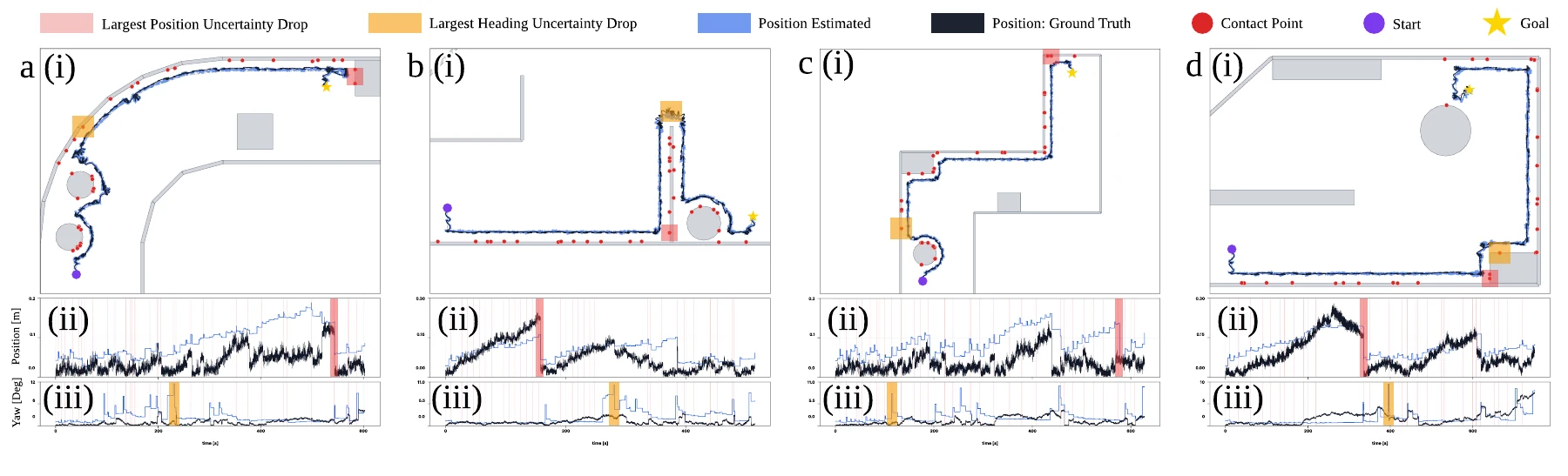
Across four maps, TAPNAV maintains estimated trajectories close to the simulator ground
truth. Contacts with different surface normals around corners and pillars provide
complementary position constraints, while flat-wall contacts reduce uncertainty along
the surface normal and can also reduce heading uncertainty.
Map 01
TAPNAV
Video coming soon
Random-touch
Video coming soon
Sweep-touch
Video coming soon
Odometry-only
Map 02
TAPNAV
Video coming soon
Random-touch
Video coming soon
Sweep-touch
Video coming soon
Odometry-only
Map 03
TAPNAV
Video coming soon
Random-touch
Video coming soon
Sweep-touch
Video coming soon
Odometry-only
Map 04
TAPNAV
Video coming soon
Random-touch
Video coming soon
Sweep-touch
Video coming soon
Odometry-only
TAPNAV navigation performance in simulation. Each map shows the estimated and
ground-truth trajectories, tactile contact points, and the corresponding position and
yaw uncertainty and error over time.
Over 20 trials per map and method, TAPNAV achieves a 95% average success rate, compared
with 77.5% for Random-touch, 38.8% for Sweep-touch, and 22.5% for Odometry-only, while
producing lower position error and comparable yaw error.
Real-World Experiments
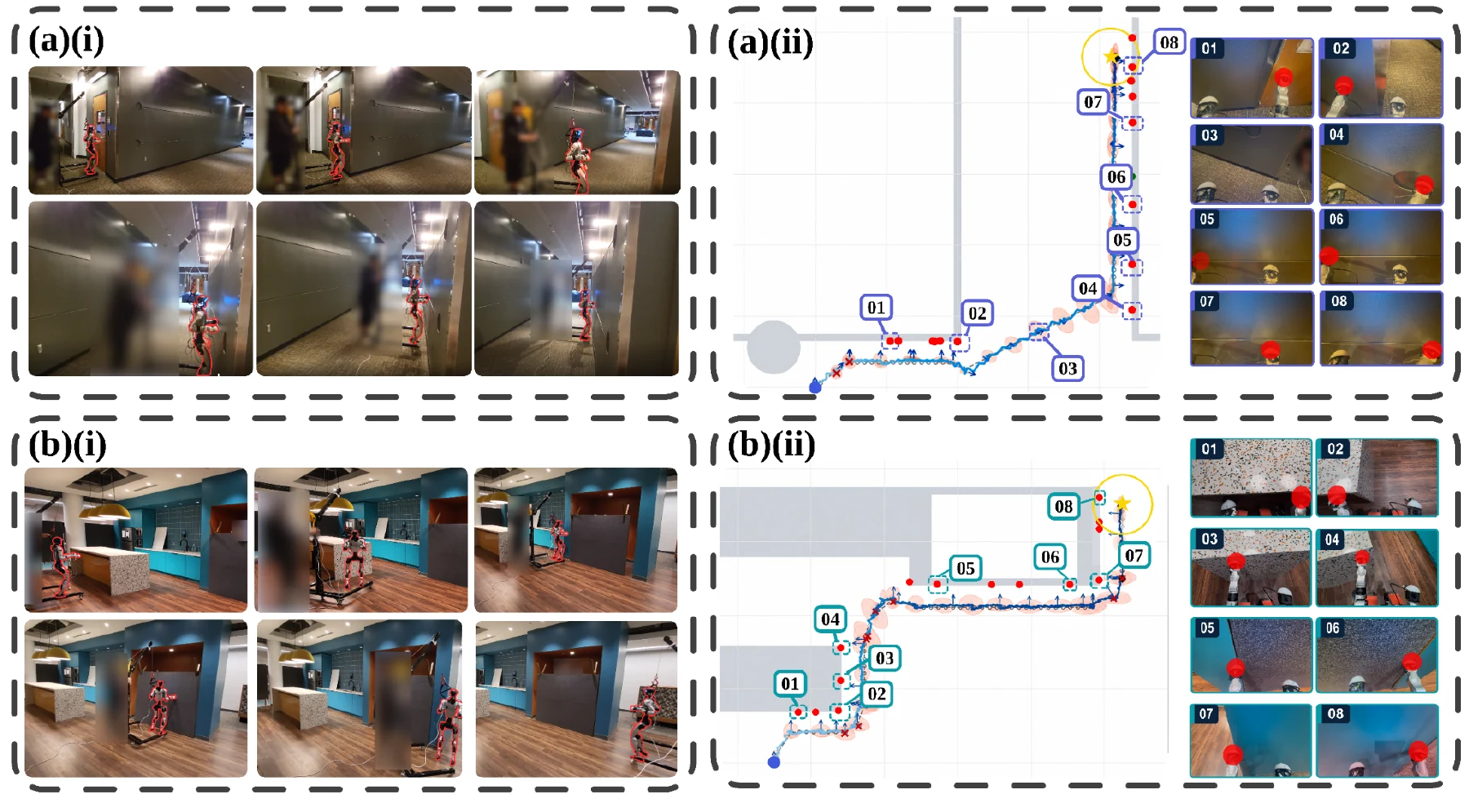
We deploy TAPNAV on a Unitree G1 with tactile end-effectors in an office hallway and a
kitchen. The robot makes successive turns, navigates around the counter, and actively
probes surfaces with different contact geometry while moving toward the goal.
Trial 01
TAPNAVOdometry-only (2.74× speed)
Trial 02
TAPNAVOdometry-only (9.52× speed)
TAPNAV deployed on a Unitree G1 in an office hallway and kitchen. Each environment
shows deployment snapshots together with the robot path and active tactile probes in
the robot's egocentric view.
Drift Recovery
Drift Recovery
Low-Level Controller Accuracy
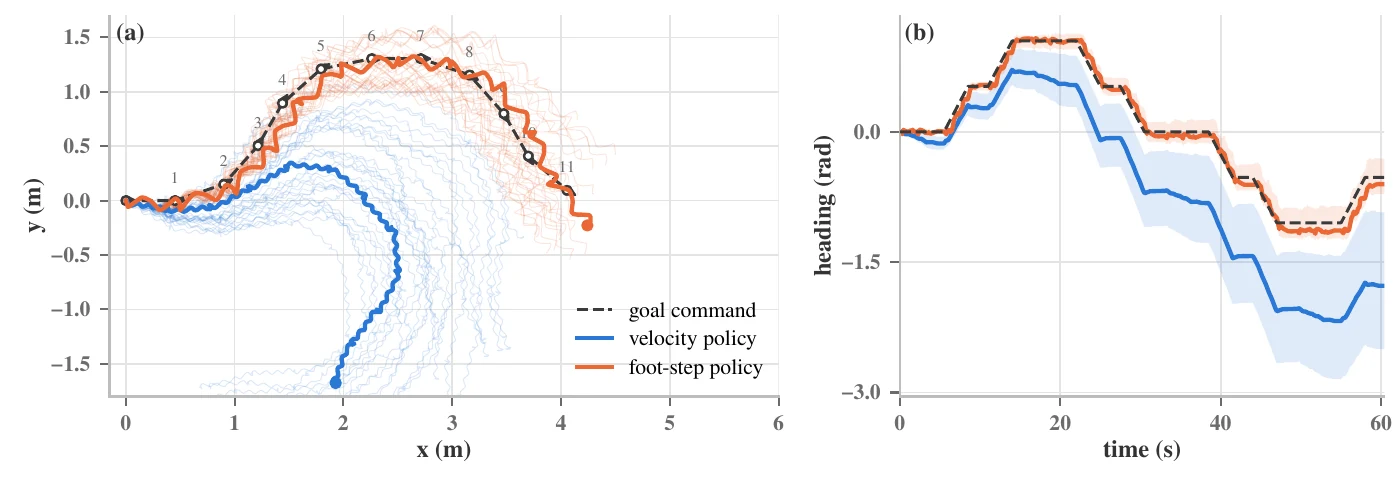
Simulated open-loop goal tracking with velocity- and footstep-tracking policies over
30 trials per policy: executed trajectories and actual versus commanded heading.
We compare TAPNAV's footstep controller with a velocity-tracking controller on a
sequence of global planar torso targets. Heading errors accumulate under velocity
tracking, while the footstep controller follows the target sequence with minimal drift.
Yaw-Noise Sensitivity
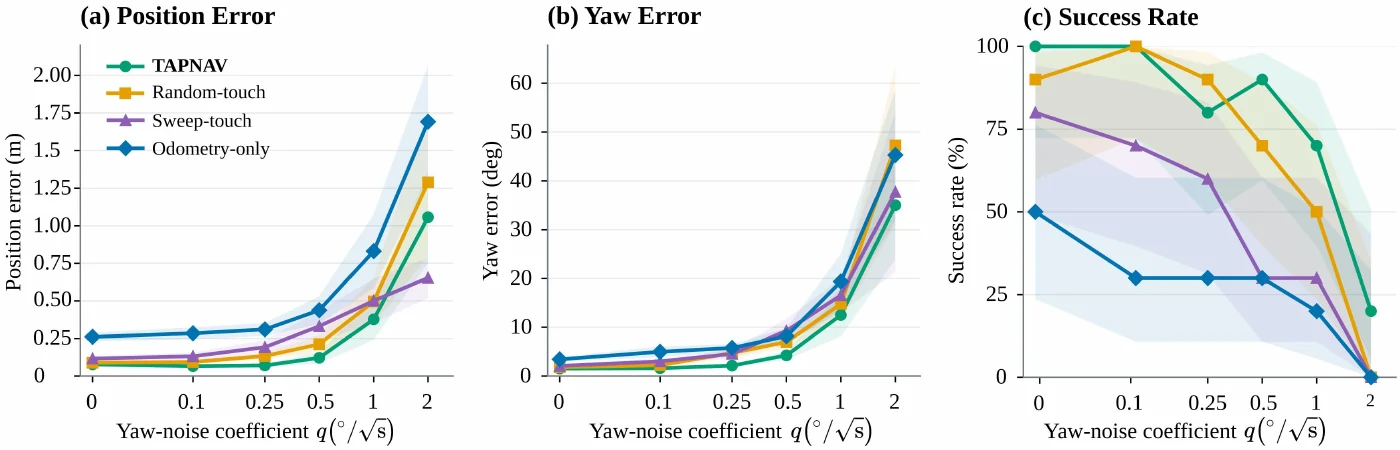
Yaw-noise sensitivity: position error, yaw error, and success rate. Bands and bars
show mean +/- standard error and 95% confidence intervals.
Under increasing IMU heading noise, TAPNAV retains the lowest mean position and yaw
errors and the highest success rate among the evaluated methods.
Conclusion
TAPNAV integrates tactile active probing, belief-space localization, uncertainty-aware
global planning, and whole-body control for vision-denied humanoid navigation. Simulation
and hardware experiments demonstrate goal-directed navigation using tactile feedback,
with improved navigation success and lower pose error than simulation baselines. The
current system assumes a known static floor plan and a unimodal Gaussian approximation of
the particle belief during planning.
BibTeX
@inproceedings{anonymous2027TAPNAV,
  title     = {TAPNAV: Humanoid Navigation through Tactile Active Perception},
  author    = {Anonymous Authors},
  booktitle = {Under Review},
  year      = {2027}
}